My FemiCore Review After 90 Days: Ingredients, Evidence, and What to Know Before You Order

Contents
FemiCore
49 USD
Pros
- One capsule a day
- Probiotic strains named on the label
- No stimulants listed
- 60-day money-back guarantee
- Free US shipping on larger packages
Cons
- Per-ingredient doses not disclosed
- No CFU count for the probiotics
- Return shipping not covered
 This FemiCore review is based on three months of using the capsules and on a close read of everything the company publishes: the Supplement Facts panel, the sales page, the shipping and refund policies, and the reference list. FemiCore is a once-daily capsule marketed to women for bladder comfort, urinary system health, and microbiome balance. I used it for 90 days, I was very pleased with the results, and I recommend it. Here is exactly what is in the capsule, what the research behind each ingredient shows, and what is worth knowing before you order, so you can decide with confidence.
Two notes on how to read it. When I describe what the manufacturer says the product does, I will say it is the manufacturer’s claim. My own experience has its own section, and it is one person’s account, not a clinical result. Also, leaking urine and frequent urges are health concerns as well as product questions, so I will point out where a conversation with a clinician makes sense [13].
FemiCore Review: Quick Verdict
Detail | Quick Verdict |
|---|---|
My rating | 9.0/10 |
Do I recommend it? | Yes. I recommend FemiCore to adult women who are not pregnant or nursing, and who have checked with a clinician first if they take medication or have a medical condition. |
What it is | A once-daily capsule with a 350 mg herbal blend and a 50 mg probiotic blend |
What I liked | Gradual improvement from the first few weeks, no side effects, a one-capsule routine, and a clear 60-day refund policy |
What to know before you order | Amounts for each ingredient inside the two blends are not itemized, so customer service is the place to ask for details |
Price | $49 to $79 per bottle depending on the package; each bottle holds 30 capsules |
Official website |
A 9.0 reflects what I experienced and how straightforward the purchase is. I noticed gradual improvements in bladder comfort and urinary control, I felt more confident in my daily routine, and I had no side effects across the full three months. The few points I flag below are simply things worth knowing before you order, and none of them changed my recommendation.
What Is FemiCore?
FemiCore is a dietary supplement sold in bottles of 30 gelatin capsules and distributed by a company of the same name based in Tallmadge, Ohio [1]. The front of the label lists three areas of support: healthy urinary system, bladder control support, and microbiome balance. Each carries a dagger pointing to the standard FDA disclaimer, which says the statements have not been evaluated by the Food and Drug Administration and that the product is not intended to diagnose, treat, cure, or prevent any disease [1].
Read more: YuSleep Review (2026): What I Noticed After 3 Months of Regular Use
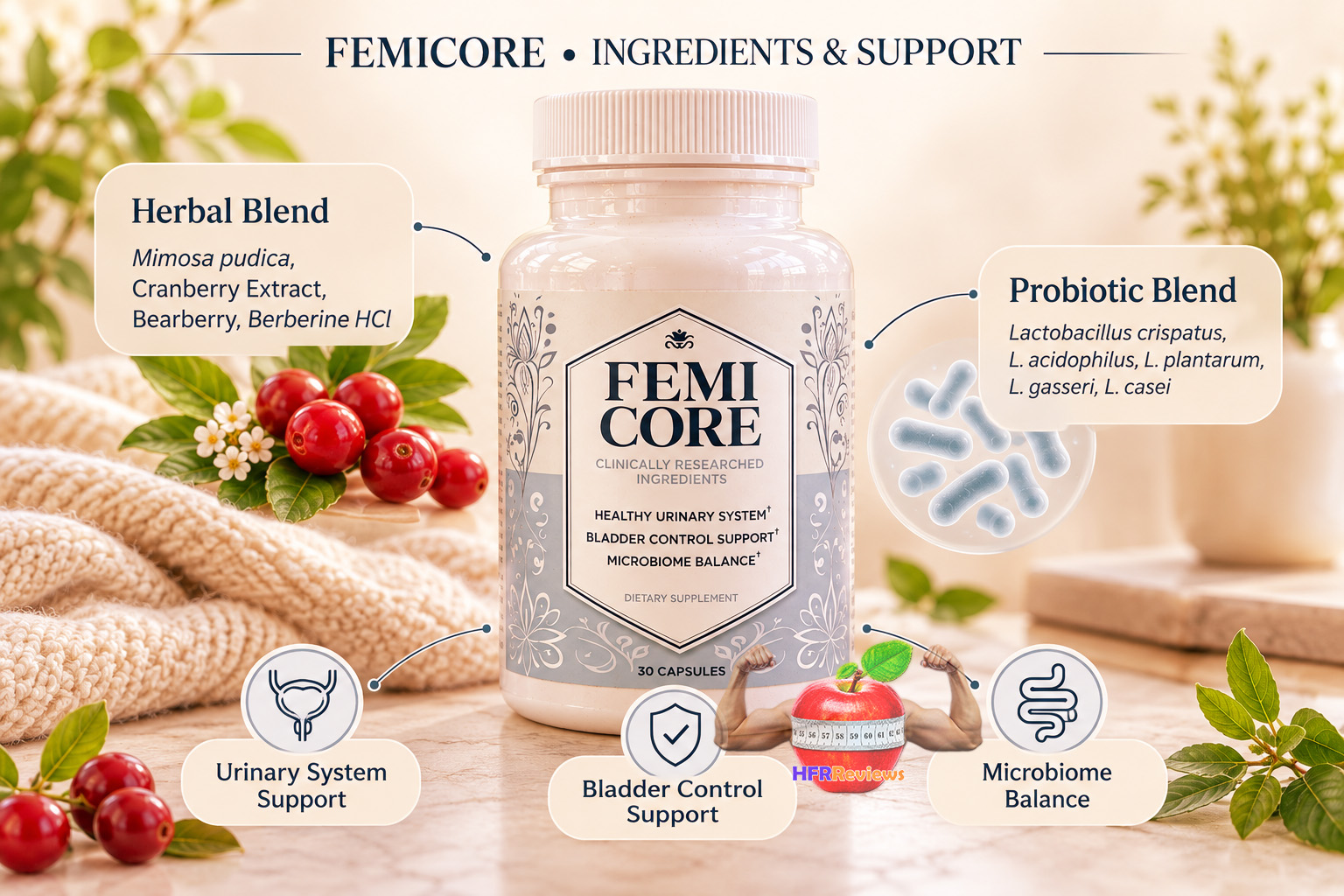
The formula has two parts. A herbal blend combines Mimosa pudica seed extract, cranberry extract, bearberry leaf, and berberine hydrochloride extract. A probiotic blend adds five Lactobacillus strains. Together they total 400 mg per capsule [1]. The manufacturer’s explanation, which is a claim and not an established mechanism, is that the formula is designed to support bladder health by addressing an imbalance in the urinary microbiome [2]. The label lists no caffeine or other stimulant, which fits the sales page’s “no stimulants” line [1][2].
The sales page describes the purchase as one-time, with no autoship [2]. It names ClickBank as the retailer for orders, while product questions go to the manufacturer [2][3].
FemiCore Quick Facts
Detail | Information |
|---|---|
Product name | FemiCore |
Official website | |
Customer Service | [email protected] (product support). Order support through ClickBank: 1-800-390-6035 (toll free) and +1 208-345-4245 (international) [3] |
Product category | Dietary supplement for women: urinary and bladder support, microbiome support |
Customer satisfaction | No independently verified rating available. The sales page cites 19,263 reviews, which I could not verify [2]. My rating: 9.0/10 |
Manufacturing country | USA |
Product composition | Per capsule: Herbal Blend 350 mg (Mimosa pudica seed extract, cranberry extract standardized to 30% proanthocyanidins, bearberry leaf, berberine HCl extract 8%) and Probiotic Blend 50 mg (L. crispatus LCrB6, L. acidophilus LA88, L. plantarum NT3, L. gasseri LG08, L. casei LC16) [1] |
FDA & GMP approved? | Dietary supplements are not FDA-approved before sale [6][10]. The label shows a GMP badge and says it is made in an FDA-registered facility, but it names no certifying body, so I treat GMP as stated on the label and not independently confirmed [1] |
Money-back policy | 60 days from the delivery date. All bottles (empty or not) and the packing slip must be returned, and return shipping is not covered [4] |
Shipping countries | United States, Canada, UK and Ireland, Australia and New Zealand [3] |
Delivery time and price | US: free, 5-7 working days. Canada, UK/Ireland, Australia/New Zealand: $15.95, 10-15 working days [3]. The sales page also shows +$9.99 shipping on the 2-bottle package, so confirm at checkout [2] |
Recommended supply | The manufacturer recommends the 6-bottle package (180 days) [2] |
Where to buy | Official website (ClickBank is the named retailer) [2] |
Not recommended to | Pregnant or nursing women, anyone under 18, and people with a known medical condition unless a physician agrees [1]. See the safety section below |
Suggested use | One capsule daily with water; the website suggests taking it in the morning [1][2] |
Serving size | 1 capsule [1] |
Servings per container | 30 [1] |
FemiCore Ingredients: What Each One Does and What the Evidence Says
For this FemiCore review, I looked at each ingredient the way I would for any supplement: what role it is meant to play, how strong the evidence is, and what is worth knowing before you buy. The “evidence level” notes are my own plain-language summary of the sources I opened, not a formal grade.
Mimosa pudica seed extract
Intended role. The manufacturer lists it first in the herbal blend and presents it as part of the bladder-supporting formula [2]. Mimosa pudica is a creeping plant used in traditional herbal practice.
Evidence level: early, laboratory stage. The one study on the plant I could open is a 2022 paper that tested a leaf extract, not a seed extract, against four bacterial strains in a dish and ran a computer model of a compound called L-mimosine [12]. The authors describe the compound as a lead for future antibacterial research [12].
Good to know. I found no human data on Mimosa pudica for urinary comfort, the study I read used a different plant part, and the label does not say how much is in each capsule. I see it as the traditional-use botanical in the blend.
Cranberry extract (standardized to 30% proanthocyanidins)
Intended role. Cranberry is the best-known ingredient here. NCCIH explains that its proanthocyanidins (PACs) are thought to keep bacteria from sticking to the bladder wall [6].
Evidence level: moderate for one narrow use, limited for everything else. Many studies have looked at cranberry for preventing urinary tract infections. In general, cranberry products may lower the risk of symptomatic recurrent UTIs in women, but the findings are inconsistent and some of the research is not high quality [6]. NCCIH also notes that there is little research on cranberry for other conditions, which includes bladder control [6].
Good to know. Processing cranberry into tablets or capsules can lower PAC concentration, which can reduce how well a product works [6]. FemiCore tells us the extract is standardized to 30% PACs but not how much extract a capsule holds. Simple arithmetic gives a ceiling: even if the entire 350 mg herbal blend were cranberry extract, PACs could not exceed about 105 mg, and because four ingredients share the blend, the real figure is lower. Cranberry is not a treatment for an existing infection [6].
Bearberry leaf
Intended role. Bearberry leaf (uva-ursi) has a long history in European herbal medicine. A European Medicines Agency committee monograph describes it as a traditional herbal medicinal product for symptoms of mild recurrent lower urinary tract infections in women, after serious conditions have been excluded by a doctor, and states that this use rests on long-standing tradition [9].
Evidence level: traditional use, with clinical testing still catching up. The manufacturer’s reference list includes a 2022 protocol for a bearberry trial in acute cystitis, which describes a planned study and not results [5].
Read more: Phytomem One Reviews (2026): Ingredients, Dosing, Evidence, Side Effects
Good to know. The monograph describes specific standardized preparations, with a single dose corresponding to 100-210 mg of hydroquinone derivatives, and it limits use to one week [9]. The dry extracts it describes contain roughly 20 to 29% hydroquinone derivatives [9], so one dose would need on the order of 340 mg of extract or more. FemiCore’s entire herbal blend is 350 mg and has to hold three other ingredients, so the bearberry portion is almost certainly far below that single-dose level. That may be reassuring about exposure, and the exact amount is something the manufacturer does not state. The one-week limit matters because FemiCore is designed for daily use; I come back to this in the safety section.
Berberine hydrochloride extract (8%)
Intended role. Berberine is a compound found in plants such as European barberry, goldenseal, and Oregon grape. NCCIH notes that berberine-containing plants have traditionally been used against various bacteria, fungi, and viruses [7].
Evidence level: some evidence for blood glucose and cholesterol, none that I found for bladder control. NCCIH reports some evidence of a modest effect on blood glucose in people with type 2 diabetes and a possible effect on cholesterol, while the evidence for weight loss is not rigorous enough to judge [7]. The manufacturer’s reference list includes a rat study on bladder muscle contraction in diabetic animals [5], which is a long way from human bladder control.
Good to know. An 8% extract means 8% of the material is berberine. If the whole herbal blend were this extract, a capsule could hold at most 28 mg of berberine, and in practice less. Berberine is also the ingredient that needs the most care around pregnancy and medicines, which I cover under safety [7].
Probiotic strains
Intended role. The probiotic blend lists five strains: Lactobacillus crispatus LCrB6, L. acidophilus LA88, L. plantarum NT3, L. gasseri LG08, and L. casei LC16 [1]. NCCIH defines probiotics as live microorganisms intended to have health benefits and stresses that effects are strain-specific: a benefit from one kind of Lactobacillus does not mean another kind would do the same [8].
Evidence level: limited for this use. NCCIH’s summary describes a 2015 review of nine studies of probiotics for preventing urinary tract infections that did not find evidence of a beneficial effect [8]. Naming strains down to the designation is a good sign of specificity, but I did not find published human studies on these exact strains in the sources I reviewed.
Good to know. The label gives a weight, 50 mg for the whole blend, and no CFU (colony-forming units) count, so you cannot tell how many live organisms a capsule delivers. NCCIH also notes that some probiotic products have been reported to contain organisms other than those listed on the label [8]. That is a reminder that label detail matters, and that asking the manufacturer for testing information is reasonable.
FemiCore Proprietary Blends: What the Label Tells Us
 Both active components are proprietary blends. That is common in supplements, so here is exactly what the label shows.
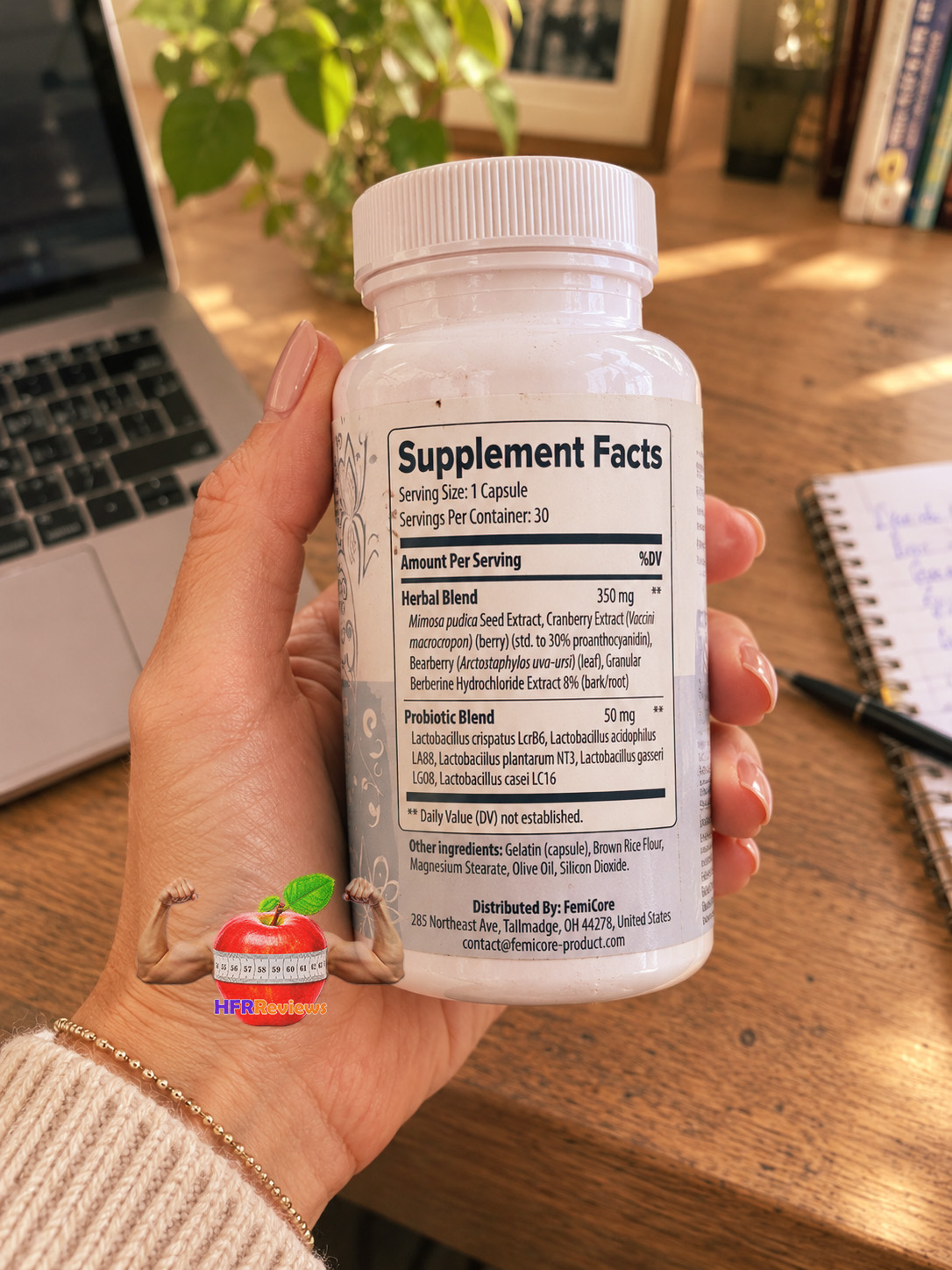
What the label does tell us: the total weight of each blend (350 mg herbal, 50 mg probiotic), the 400 mg combined total, the 30% PAC standardization of the cranberry extract, the 8% grade of the berberine extract, the named probiotic strains, and the other ingredients: gelatin, brown rice flour, magnesium stearate, olive oil, and silicon dioxide [1].
What is not itemized: how much of each herb is in the 350 mg, how many live organisms are in the 50 mg, and whether the strains stay viable through the shelf life.
Because the amounts are missing, the only honest arithmetic is a set of ceilings, not estimates:
Item | What the label says | Upper limit per capsule |
|---|---|---|
Cranberry PACs | Extract standardized to 30% PACs | 105 mg, only if the whole herbal blend were cranberry (it is not) |
Berberine | 8% berberine extract | 28 mg, only if the whole herbal blend were this extract (it is not) |
Probiotic organisms | 50 mg blend, no CFU listed | Cannot be calculated from weight |
Real amounts are lower than these ceilings, and customer service is the place to ask for exact figures.
One more question is worth asking. Berberine-containing plants have traditionally been used against bacteria, fungi, and viruses [7], and nothing on the label explains how the formula pairs berberine with live probiotic strains. I did not find stability data either. This is a fair question for customer service at [email protected], and a clear answer would be useful to every buyer.
Does FemiCore Work? What the Research Supports
 A FemiCore review should answer three questions: is the idea plausible, is there evidence for the ingredients, and has the finished product been tested?
Plausibility. Researchers have been studying the bladder’s own bacterial community, called the urobiome. In one study discussed by its authors, catheterized urine samples from over 300 adult women were compared, and women with urinary incontinence had a higher frequency of detectable bacteria than women without it, with similar trends by symptom severity [11]. The authors say further study is needed to determine whether those differences are a cause or an effect of incontinence, and they describe the urobiome as a possible future target for prevention, diagnosis, and treatment [11]. That makes the manufacturer’s microbiome rationale a reasonable one, and an area of active research.
The ingredients. As covered above, cranberry has the most research, focused on UTI prevention with mixed results [6]. Bearberry rests on traditional use [9]. Berberine has been studied mainly for blood glucose and cholesterol [7]. Mimosa pudica has laboratory data [12]. Probiotics show mixed evidence that depends on the strain and the condition [8]. Together, they give the formula a reasoned basis, with each ingredient bringing its own research history.
The finished product. The manufacturer’s reference list gathers research on the individual ingredients and on the urinary microbiome, and it does not include a clinical trial of the finished capsule [5]. I treat it as useful background, and I rely on my own three months and the refund policy as the practical tests.
Where my experience fits. My results were positive: gradual improvements within the first few weeks, particularly in bladder comfort and urinary control. I treat that as a real but individual experience. It does not replace a controlled study, and yours may differ.
One more point that matters. NIDDK describes urinary incontinence as a medical problem with several types, says a doctor can help identify which type you have, and notes that many women improve with treatment, including bladder training and pelvic floor exercises and, for overactive bladder, prescription medicines [13]. The way I would position FemiCore is as a supplement designed to support urinary comfort alongside that kind of care, not as a replacement for it.
FemiCore Marketing Claims vs. Evidence
The sales page is enthusiastic, as sales pages tend to be. A FemiCore review should separate claims from findings, so here is how its main statements line up with the research. These are the manufacturer’s statements, not my conclusions.
Manufacturer’s claim | What I found |
|---|---|
The formula is designed to support bladder health through the urinary microbiome | Researchers are actively studying the urobiome and its links to incontinence, with cause and effect still being explored [11] |
The ingredients are “clinically researched” | Each main ingredient has its own research history, from cranberry to probiotics [5][6][8] |
“No stimulants” | Consistent with the label: no caffeine or similar ingredient is listed [1] |
Statements about preventing leaks or addressing dioxins | Not on the label, which uses “support” wording and the FDA disclaimer [1]. I read these as the manufacturer’s own marketing language |
“Optimally dosed” and “Non-GMO” | Per-ingredient amounts are not itemized and Non-GMO is not stated on the label [1]; customer service can confirm both |
My recommendation rests on my own experience and on the refund policy, which together give you a practical way to judge FemiCore for yourself.
FemiCore Reviews From Customers: What to Make of Them
The sales page reports 19,263 customer reviews with a star graphic [2]. That figure comes from the manufacturer and is not independently verified, as is the statement that 96% of customers order six bottles [2].
Testimonials on any sales page are unverified, so I would weigh them lightly in any FemiCore review. What I find more reassuring is that the 60-day refund policy lets you test FemiCore for yourself, and I cover it below.
My FemiCore Review: Three Months of Use
I used FemiCore for three months. Within the first few weeks I began noticing gradual improvements, mostly in bladder comfort and urinary control. They were gradual, not sudden, and I did not treat the first few weeks as a verdict. Over time I felt more comfortable and more confident in my daily routine.
I had no side effects at any point during the three months.
Overall, FemiCore exceeded my expectations and left me with a very positive impression. That is why I rate it 9.0/10 and recommend it.
Some context so you can weigh that fairly. This is one person’s experience over 90 days. I am not claiming FemiCore caused the changes I noticed, and I am not offering numbers, because a review should stick to what can be supported. The manufacturer’s refund page suggests using the product for at least three months before reaching a conclusion [4]. That happens to be the length of my trial, and I think it is a sensible window to give it. Your results may be faster, slower, or different.
FemiCore Side Effects and Safety
A responsible FemiCore review has to cover safety. I had no side effects in three months of use, but that is my experience only, so here is what the sources say.
What the label says
The label advises not exceeding the recommended dose. It says pregnant or nursing women, children under 18, and people with a known medical condition should consult a physician before use. It also says to keep the product out of the reach of children and not to use it if the safety seal is damaged or missing [1].
Ingredient-specific cautions
- Berberine. NCCIH lists abdominal pain, constipation, diarrhea, nausea, and vomiting as the most common adverse effects. People who are pregnant or breastfeeding should not use berberine, and it should not be given to infants, because it can cause or worsen jaundice in newborns and may lead to a life-threatening brain condition called kernicterus. It might also interact with medicines [7].
- Bearberry. The European monograph for bearberry leaf preparations lists kidney disorders as a contraindication, advises avoiding use during pregnancy, does not recommend use during lactation or under age 18, and reports nausea, vomiting, and stomach pain. It can turn urine greenish-brown, and it limits use to one week. Fever, painful urination, spasms, or blood in the urine should prompt a visit to a doctor [9]. That time limit applies to the preparations the monograph describes, and FemiCore does not disclose its bearberry amount. If you plan to take FemiCore for months, mention bearberry to your clinician, especially if you have any kidney concern.
- Cranberry. Cranberry by mouth is generally thought to be safe, though very large amounts can cause stomach upset and diarrhea. Evidence is conflicting on whether it interacts with the blood thinner warfarin, and pregnant or breastfeeding women are advised to consult a provider [6].
- Probiotics. Side effects are usually few in healthy people, but safety data, especially long-term data, are limited, and the risk may be greater for people with severe illness or weakened immune systems [8].
- Mimosa pudica. I did not find human safety data in the sources I reviewed.
- Capsule. The capsule is gelatin, so FemiCore is not suitable for strict vegetarians or vegans [1].
Medicines and medical conditions
Berberine has been studied for effects on blood glucose, cholesterol, and blood pressure [7], so anyone taking medicine for diabetes, cholesterol, or blood pressure should check with a clinician or pharmacist first. The same applies to anyone taking warfarin or other blood thinners [6], and to people with a serious illness or a weakened immune system [8]. NIDDK also points out that some medicines, including pills for swelling or high blood pressure, can contribute to bladder control problems, so the cause may sit on the prescription list and not in the bladder [13]. Do not change a prescribed medicine on your own.
When to see a clinician first
NIDDK is direct: urinary incontinence is a medical problem, and the first step is seeing a doctor to learn which type you have [13]. A urinary tract infection can itself cause temporary incontinence [13]. Fever, painful urination, or blood in the urine call for medical care and not for a supplement [6][9]. FemiCore is a dietary supplement designed to support urinary comfort. It does not treat, cure, or prevent a disease, and it does not replace medical care.
How to Take FemiCore
The label says adults take one capsule daily with water and should not exceed the recommended dose [1]. The website suggests one capsule in the morning with a large glass of water [2]. That is the whole routine, which is one of the reasons I found it easy to stay consistent.
Read more: Unlocking the Benefits of Vitamin A for a Healthy Body and Mind. Best Vitamin A Dietary Supplements
A few practical suggestions that are mine, not the manufacturer’s. Pick a time you will remember and keep it the same. If you want a clearer picture of whether the product is helping you, a simple bladder diary of urination times and any leaks is the same tool doctors use to evaluate bladder problems, and it gives your clinician useful information if you decide to book a visit [13]. Give it time: the refund page suggests at least three months before judging [4], and I noticed gradual changes within the first few weeks. Store it in a cool, dry place and keep the bottle sealed, as the label directs [1].
FemiCore Price and Packages
This FemiCore review covers the three packages sold on the official site. The per-day figures below are my own calculation from the listed prices, using 30 capsules per bottle and one capsule per day.
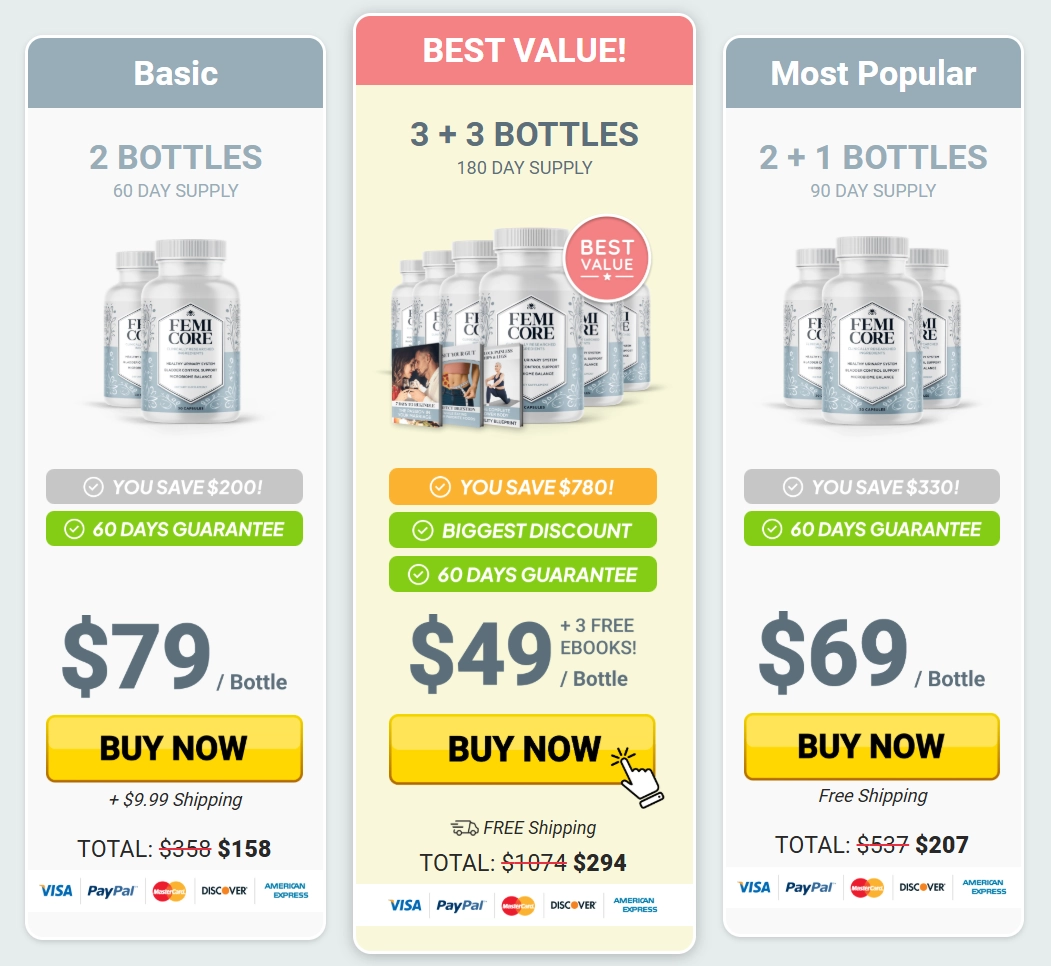
Package | Bottles | Supply | Price | US shipping | Per bottle | Per day |
|---|---|---|---|---|---|---|
Basic | 2 | 60 days | $158 | +$9.99 on the sales page; free per the shipping policy [2][3] | $79 | $2.63 ($2.80 with $9.99 shipping) |
Most Popular | 2 + 1 free = 3 | 90 days | $207 | Free | $69 | $2.30 |
Best Value | 3 + 3 free = 6 | 180 days | $294 | Free | $49 | $1.63 |
The sales page shows crossed-out totals of $358, $537, and $1,074, which work out to $179 per bottle [2]. I base my view on the prices you actually pay, which come to $49 to $79 per bottle. International orders carry a $15.95 shipping fee [3].

The six-bottle package also includes three digital bonus guides on relationships, digestion, and hip mobility [2].
The 3- and 6-bottle packages carry the lowest daily cost, down to $1.63, and the refund policy I reviewed describes a single 60-day window for orders [4].
FemiCore Money-Back Guarantee
In my FemiCore review, the refund policy stands out as one of the product’s strongest points, and the procedure is simple if you follow it exactly [4].
- Timing. Refund requests are accepted for 60 days from the delivery date.
- Contact. Email [email protected] with the subject line “Refund Request.”
- Return. Send all bottles, including empty ones, along with the packing slip to the address given on the policy: 285 Northeast Ave, Tallmadge, OH 44278.
- Cost. Return shipping is paid by you.
- Refund. The refund is processed within a few days of receipt, and it can take 5 to 10 days to appear on a card.
Here is what I would do to keep it smooth. Note the delivery date the day the package arrives. Keep the packing slip and the order confirmation together. Keep the empty bottles instead of discarding them, since they must be returned. Ship with tracking and photograph the contents before sealing the box. Send your request email before the window closes and save the reply. For order status questions, ClickBank order support is listed at 1-800-390-6035 [3]. Mark the delivery date on your calendar so you know exactly when the 60 days end [4].
FemiCore Alternatives
I am not comparing brands in this FemiCore review, because I would need to evaluate each one with the same care. Instead, here are the main categories of options and how they differ from FemiCore. They are not mutually exclusive, and a clinician can help you combine them sensibly.
Option | What it is | What the sources say |
|---|---|---|
Bladder training and pelvic floor exercises | Behavioral approaches such as timed voiding and Kegel exercises | NIDDK describes these as first-line behavioral remedies, and notes bladder control may not improve for 3 to 6 weeks of regular practice [13] |
Medical evaluation and prescription options | A visit to a doctor, urologist, or urogynecologist | NIDDK says the first step is identifying the type of incontinence; for overactive bladder, prescription medicines exist and carry side effects such as dry mouth [13] |
Cranberry-only supplements | Single-ingredient cranberry capsules or products | NCCIH describes mixed evidence for preventing recurrent UTIs, and notes that capsules can vary in PAC content [6] |
Probiotic-only supplements | Single- or multi-strain probiotics | NCCIH stresses that effects are strain-specific and evidence is limited for urinary uses [8] |
Fluid habits | Adjusting drinks such as coffee, tea, and alcohol | NIDDK notes many people reduce leakage by restricting certain liquids [13] |
FemiCore sits in a different place from all of these: a combined herbal and probiotic capsule meant to be taken daily. The first two rows are the best reference point for any ongoing concern.
FemiCore Review Pros and Cons
Pros
- Simple one-capsule-a-day routine
- Probiotic strains are named down to the strain designation
- No stimulants listed on the label
- 60-day money-back guarantee with a clearly written procedure
- Free US shipping on the 3- and 6-bottle packages, and a low per-day cost on the larger packages
Cons
- Per-ingredient amounts inside each blend are not itemized
- No CFU count listed for the probiotic blend
- Return shipping is paid by the customer
FemiCore Review: Final Verdict
Here is where I land. I used FemiCore for three months, I noticed gradual improvements in bladder comfort and urinary control beginning in the first few weeks, I felt more confident in my daily routine, and I had no side effects. It exceeded my expectations. My rating is 9.0/10, and I recommend FemiCore to adult women who are not pregnant or nursing and who have talked to their clinician first if they take medication or have a medical condition.
What stands out to me is the combination: cranberry, which has been widely studied for urinary tract health, bearberry, which has a long history of traditional use, and five named probiotic strains, all in one capsule a day. Two things to keep in mind: your own results may differ from mine, and the blends do not itemize per-ingredient amounts, so customer service is the place to ask for details. The 60-day refund policy gives you a clear, low-risk way to try FemiCore for yourself.
If this FemiCore review has you considering a purchase, order through the official website: FemiCore official website. Check the shipping cost at checkout, since the sales page and the shipping policy differ on the smallest package.
Have you tried FemiCore? I would like to hear how it went for you. Share your own FemiCore review in the comments: how long you used it, when you noticed anything, and what your overall impression was. Your experience can help other readers decide. Please keep personal medical details general.
Share Your FemiCore Experience in the Comments
Have you tried FemiCore? Your experience can help other readers decide, so I would like to hear it. Share your own FemiCore review in the comments and tell us:
- How long you have taken it
- When you first noticed any change, if you did
- Whether you had any side effects
- Your overall impression, and whether you would order it again
Questions are welcome too. Please keep personal medical details general, and remember that nothing in the comments replaces advice from your own clinician.
FemiCore Review FAQ
Is FemiCore FDA approved? No. Dietary supplements are not approved by the FDA before they are sold [6][10]. FemiCore’s label carries the standard disclaimer that its statements have not been evaluated by the FDA [1]. A line about an FDA-registered facility describes the facility and does not mean the product is approved.
How long does it take to notice anything? It varies. I noticed gradual improvements within the first few weeks, and the manufacturer’s refund page suggests giving it at least three months [4]. Results are individual.
Who should avoid FemiCore? The label says pregnant or nursing women, children under 18, and people with a known medical condition should consult a physician first [1]. Berberine and bearberry carry additional cautions for pregnancy, and bearberry for kidney disorders [7][9].
Can I take FemiCore with prescription medicines? Ask your clinician or pharmacist first. Berberine might interact with medicines, and cranberry has conflicting evidence regarding warfarin [6][7].
Does FemiCore contain caffeine or other stimulants? None are listed on the label [1].
Is FemiCore a subscription? The sales page describes a one-time purchase with no autoship [2]. Confirm the terms at checkout.
Where should I buy FemiCore? The official website. The refund terms I reviewed are published there [4], and I cannot speak for other sellers.
References
- FemiCore product label and Supplement Facts panel (label image reviewed).
- FemiCore official page text. https://getfemicore.com/text.php
- FemiCore Shipping Policy and contact details. https://getfemicore.com/help/shipping.php
- FemiCore Refund Policy. https://getfemicore.com/help/refunds.php
- FemiCore References page. https://getfemicore.com/help/references.php
- National Center for Complementary and Integrative Health (NCCIH). Cranberry: Usefulness and Safety. https://www.nccih.nih.gov/health/cranberry
- NCCIH. In the News: Berberine. https://www.nccih.nih.gov/health/in-the-news-berberine
- NCCIH. Probiotics: Usefulness and Safety. https://www.nccih.nih.gov/health/probiotics-usefulness-and-safety
- European Medicines Agency, Committee on Herbal Medicinal Products. Community herbal monograph on Arctostaphylos uva-ursi (L.) Spreng., folium (superseded 2012 version). Link
- U.S. Food and Drug Administration. Final Rule Promotes Safe Use of Dietary Supplements (Consumer Update, June 22, 2007; archived copy). Link
- Price TK, et al. Bladder bacterial diversity differs in continent and incontinent women: a cross-sectional study. Am J Obstet Gynecol. 2020;223(5):729.e1-729.e10 (authors’ “Beyond the Abstract” commentary, UroToday). Link
- Mandal AK, et al. In vitro antioxidant and antimicrobial potency of Mimosa pudica of Nepalese Terai region: insight into L-mimosine as an antibacterial agent (2022). PubMed. https://pubmed.ncbi.nlm.nih.gov/36248409/
- National Institute of Diabetes and Digestive and Kidney Diseases (NIDDK). Urinary Incontinence in Women (archived copy). Webarchive